Tissues
Nervous system
12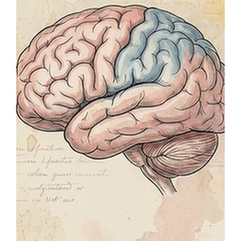
Brain
The frontal lobe is the largest and most anterior lobe of the cerebrum, critical for executive functions. It houses the primary motor cortex, which controls voluntary movements, and the prefrontal cortex, responsible for higher-order cognition such as decision-making, planning, problem-solving, personality expression, and social behavior. Damage to this area can profoundly affect an individual's character and ability to organize thoughts and actions.
Brain
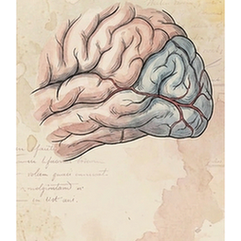
The occipital lobe is the most posterior region of the cerebrum and is exclusively dedicated to visual processing. It contains the primary visual cortex (V1), which receives raw sensory input from the eyes via the thalamus. Subsequent visual association areas interpret this data, enabling functions like object recognition, color perception, motion detection, and spatial navigation. It is the brain's central hub for making sense of what we see.
Brain
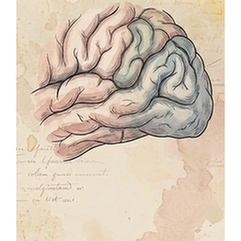
The parietal lobe, located superior to the occipital lobe and posterior to the frontal lobe, integrates sensory information. Its primary somatosensory cortex processes touch, pressure, temperature, and pain from the body. Association areas are crucial for spatial awareness, proprioception (sense of body position), hand-eye coordination, and complex perceptual functions like reading and arithmetic. It creates a coherent spatial map of the self and the environment.
Brain
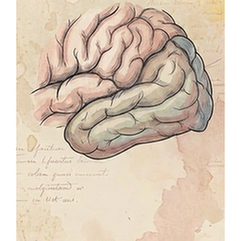
The temporal lobe lies inferior to the lateral sulcus on each cerebral hemisphere. It is vital for auditory processing via the primary auditory cortex, and for high-level visual processing related to object and face recognition. Its medial region, including the hippocampus, is fundamental for forming and retrieving long-term declarative memories. The left temporal lobe is also central to language comprehension (Wernicke's area).
Brain
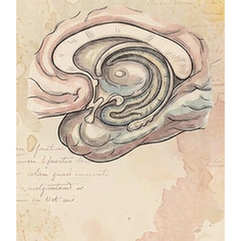
The hippocampus is a curved, seahorse-shaped structure located within the medial temporal lobe. It is the core component of the brain's limbic system and is indispensable for memory formation. Specifically, it consolidates short-term memories into long-term storage and is crucial for spatial memory and navigation. Its vulnerability makes it a primary focus in studies of Alzheimer's disease and amnesia.
Brain
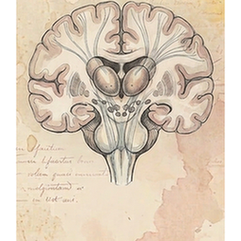
The thalamus is a paired, egg-shaped structure deep within the brain, acting as the brain's major relay station. Nearly all sensory information (except smell) passes through it, where it is filtered and directed to the appropriate cortical areas for conscious perception. It also regulates consciousness, sleep, alertness, and relays motor signals from the cerebellum and basal ganglia to the motor cortex.
Brain
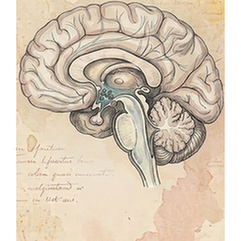
The hypothalamus is a small but master regulatory region located below the thalamus. It maintains the body's internal balance (homeostasis) by linking the nervous and endocrine systems. It controls autonomic functions like temperature, hunger, thirst, and circadian rhythms. By secreting releasing hormones, it directs the pituitary gland, thus governing growth, metabolism, stress responses, and reproductive functions.
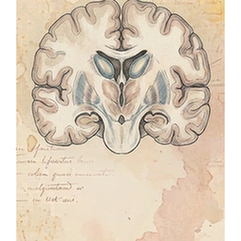
Brain
The striatum is a major input nucleus of the basal ganglia, a group of subcortical structures. Composed of the caudate nucleus and putamen, it receives extensive input from the cerebral cortex. It is critical for facilitating voluntary, purposeful movement and for procedural learning, habit formation, and reward-motivated behavior. Its dysfunction is central to movement disorders like Parkinson's and Huntington's disease.
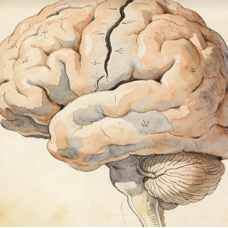
Brain
The whole brain refers to the entire encephalon, encompassing all major divisions: cerebrum (cerebral hemispheres), cerebellum, and brainstem (midbrain, pons, medulla). It is the central organ of the nervous system, responsible for integrating sensory information, generating thoughts and emotions, coordinating all voluntary and involuntary bodily functions, and enabling consciousness. It is protected by the skull and meninges.
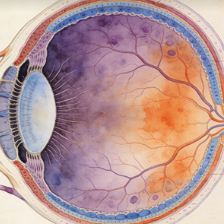
Eye
The retina is the light-sensitive neural tissue lining the back of the eye. It contains photoreceptor cells (rods for dim light, cones for color and detail) that convert light into electrical signals. These signals are processed through a network of bipolar, horizontal, and amacrine cells before being transmitted via retinal ganglion cells, whose axons form the optic nerve, carrying visual information to the brain.
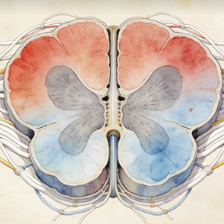
Spinal cord
The spinal cord is a long, cylindrical bundle of nerve tissue that extends from the medulla oblongata down the vertebral column. It serves as the primary conduit for motor information descending from the brain and sensory information ascending to the brain. It also contains central pattern generators for reflexes and coordinated locomotion. It is protected by the vertebrae, meninges, and cerebrospinal fluid.
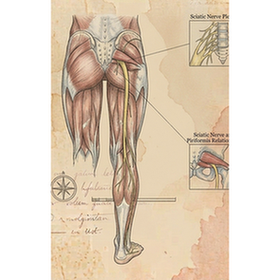
Sciatic nerve
The sciatic nerve is the largest and longest peripheral nerve in the human body. It originates from the lumbosacral plexus (L4-S3) in the lower back and runs down the posterior thigh, branching into the tibial and common fibular nerves near the knee. It provides motor innervation to the muscles of the posterior thigh, leg, and foot, and carries sensory information from these regions.
Immune system
3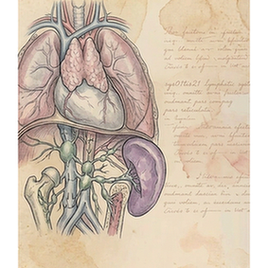
Thymus
The thymus is a primary lymphoid organ located in the upper anterior mediastinum, behind the sternum. It is most active during childhood and adolescence, where it is the site of T lymphocyte (T cell) maturation and selection. Thymic epithelial cells present self-antigens to developing T cells, eliminating self-reactive ones (negative selection) and promoting the survival of useful ones (positive selection). It undergoes involution with age.
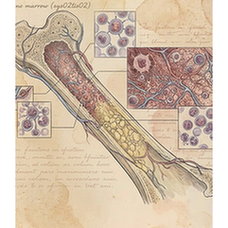
Bone marrow
Bone marrow is the soft, spongy tissue found within the cavities of bones, primarily in the pelvis, sternum, vertebrae, and ribs. It is the primary site of hematopoiesis—the production of all blood cellular components, including red blood cells (erythrocytes), white blood cells (leukocytes), and platelets. It contains hematopoietic stem cells and a supportive stromal microenvironment.
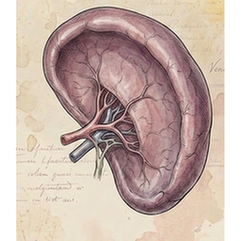
Spleen
The spleen is the largest secondary lymphoid organ, located in the left upper abdomen. It filters blood, removing old or damaged red blood cells and platelets, and captures blood-borne pathogens. Its white pulp contains immune cells (lymphocytes, macrophages) that mount immune responses. The red pulp is responsible for RBC filtration and storage. It is a key site for antibody production and immune surveillance.
Cardiovascular system
2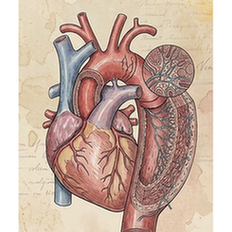
Vessel
The aorta is the largest artery in the body, originating from the left ventricle of the heart. It distributes oxygenated blood to the systemic circulation under high pressure. Its structure includes a thick, elastic wall with three layers (tunica intima, media, adventitia) that allow it to withstand and smooth out the pulsatile flow from the heart. Diseases like aneurysms and atherosclerosis primarily affect the aorta.
Heart
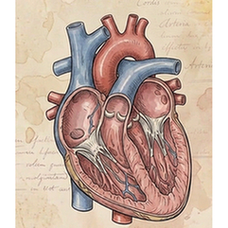
The heart is a muscular organ that functions as the central pump of the circulatory system. It has four chambers: two atria (receiving chambers) and two ventricles (pumping chambers). Through coordinated, rhythmic contractions (the cardiac cycle), it pumps deoxygenated blood to the lungs via the pulmonary circuit and oxygenated blood to the rest of the body via the systemic circuit. Its own blood supply comes from the coronary arteries.
Respiratory system
3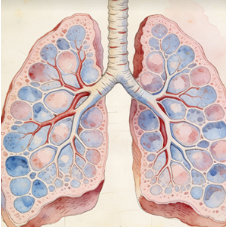
Lung
The lungs are paired, spongy, air-filled organs located in the thoracic cavity. Their primary function is gas exchange: oxygen from inhaled air diffuses into the blood in the alveoli, while carbon dioxide diffuses out to be exhaled. The branching airway tree (trachea to bronchi to bronchioles) conducts air. They also play roles in pH balance, speech, and host defense.
Trachea
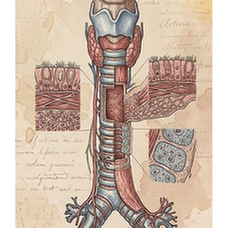
The trachea, or windpipe, is a cartilaginous tube connecting the larynx to the primary bronchi. Its C-shaped hyaline cartilage rings provide rigidity to keep the airway open, while the posterior membranous wall allows flexibility for swallowing. It is lined with ciliated pseudostratified columnar epithelium that traps and moves particles out of the airway. It is the main conduit for air to the lungs.
Diaphragm
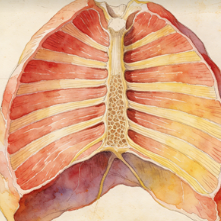
The diaphragm is a large, dome-shaped skeletal muscle that separates the thoracic cavity from the abdominal cavity. It is the primary muscle of inspiration (inhalation). When it contracts, it flattens, increasing thoracic volume and decreasing intra-thoracic pressure, drawing air into the lungs. It is controlled by the phrenic nerves (C3-C5) and also aids in defecation, urination, and childbirth.
Digestive system
4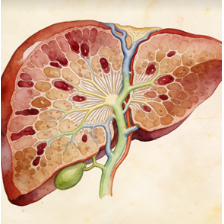
Liver
The liver is the largest internal organ and a metabolic powerhouse located in the upper right abdomen. It performs over 500 vital functions, including detoxification of metabolites, protein synthesis, production of biochemicals for digestion (bile), glycogen storage, regulation of blood glucose, synthesis of plasma proteins (e.g., albumin), and breakdown of old red blood cells. It has a remarkable capacity for regeneration.
Pancreas
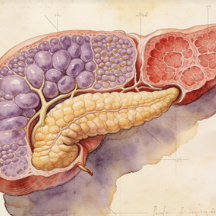
The pancreas is a dual-function gland located behind the stomach. Its exocrine portion (acinar cells) produces digestive enzymes (lipase, amylase, proteases) secreted into the duodenum. Its endocrine portion (islets of Langerhans) secretes hormones directly into the bloodstream, primarily insulin (from beta cells) and glucagon (from alpha cells), which are crucial for blood glucose regulation.
Intestine
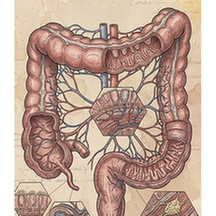
The colon, or large intestine, is the final part of the digestive tract. Its main functions are to absorb water and electrolytes from indigestible food matter, compact the remaining material into feces, and store it until defecation. It houses a vast population of commensal bacteria (gut microbiota) that ferment certain substrates and produce vitamins (like K and some B vitamins). It consists of ascending, transverse, descending, and sigmoid sections.
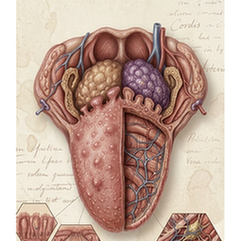
Tongue
The tongue is a muscular organ in the mouth covered with a mucous membrane. Its intrinsic and extrinsic muscles provide precise movement for speech, swallowing, and food manipulation. Its surface is covered with papillae, many of which contain taste buds for gustation (sweet, salty, sour, bitter, umami). It is also crucial for articulating speech sounds and for oral cleansing.
Reproductive system
2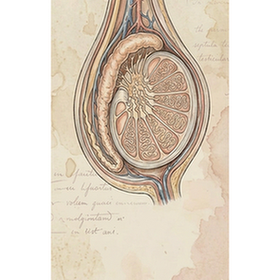
Testis
The testes (singular: testis) are the male primary gonads, housed in the scrotum. They have two primary functions: spermatogenesis, the production of spermatozoa in the seminiferous tubules; and steroidogenesis, the secretion of androgens, primarily testosterone, by Leydig cells. Temperature regulation in the scrotum is essential for normal spermatogenesis. Testosterone drives male secondary sexual characteristics and reproductive function.
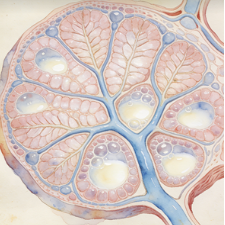
Mammary gland
Mammary glands are modified sweat glands located within the breasts. Their primary function is to produce milk (lactation) to nourish an infant. They consist of a network of ducts and lobules containing alveoli, where milk is synthesized and secreted under the influence of prolactin. Myoepithelial cells contract to eject milk in response to oxytocin. They undergo significant development during pregnancy.
Endocrine system
2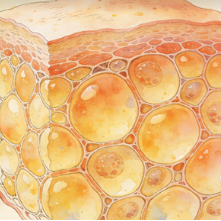
Adipose
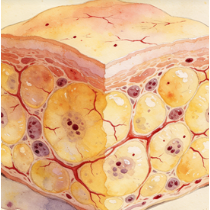
Subcutaneous adipose tissue (SAT) is the layer of fat located directly beneath the skin (the hypodermis). It serves as an energy reservoir, provides thermal insulation, and offers mechanical cushioning. Its distribution varies by sex (more in hips/thighs in females, more in abdomen in males). It also acts as an endocrine organ, secreting adipokines like leptin and adiponectin, which influence metabolism and appetite.
Adipose
Visceral adipose tissue (VAT) is body fat stored within the abdominal cavity, surrounding internal organs like the liver, pancreas, and intestines. Unlike subcutaneous fat, it is metabolically more active and is strongly associated with increased risk of metabolic diseases, including type 2 diabetes, cardiovascular disease, and insulin resistance. It releases inflammatory cytokines and free fatty acids directly into the portal circulation, affecting liver metabolism.
Urinary system
2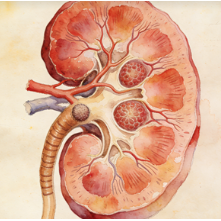
Kidney
The kidneys are paired, bean-shaped organs located retroperitoneally in the upper abdominal area. They are the body's primary filtration system, removing waste products and excess ions from blood to form urine. They critically regulate blood volume, pressure, pH, and electrolyte balance (e.g., sodium, potassium). They also produce hormones: erythropoietin (stimulates RBC production) and renin (regulates blood pressure).
Bladder
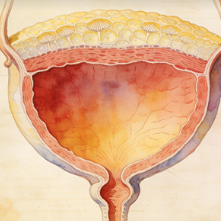
The urinary bladder is a hollow, muscular, distensible organ located in the pelvis. Its primary function is to store urine produced by the kidneys before it is excreted from the body via micturition (urination). The detrusor muscle in its wall contracts to expel urine. Its capacity and the sensation of fullness are controlled by complex neural pathways. The internal and external urethral sphincters control release.